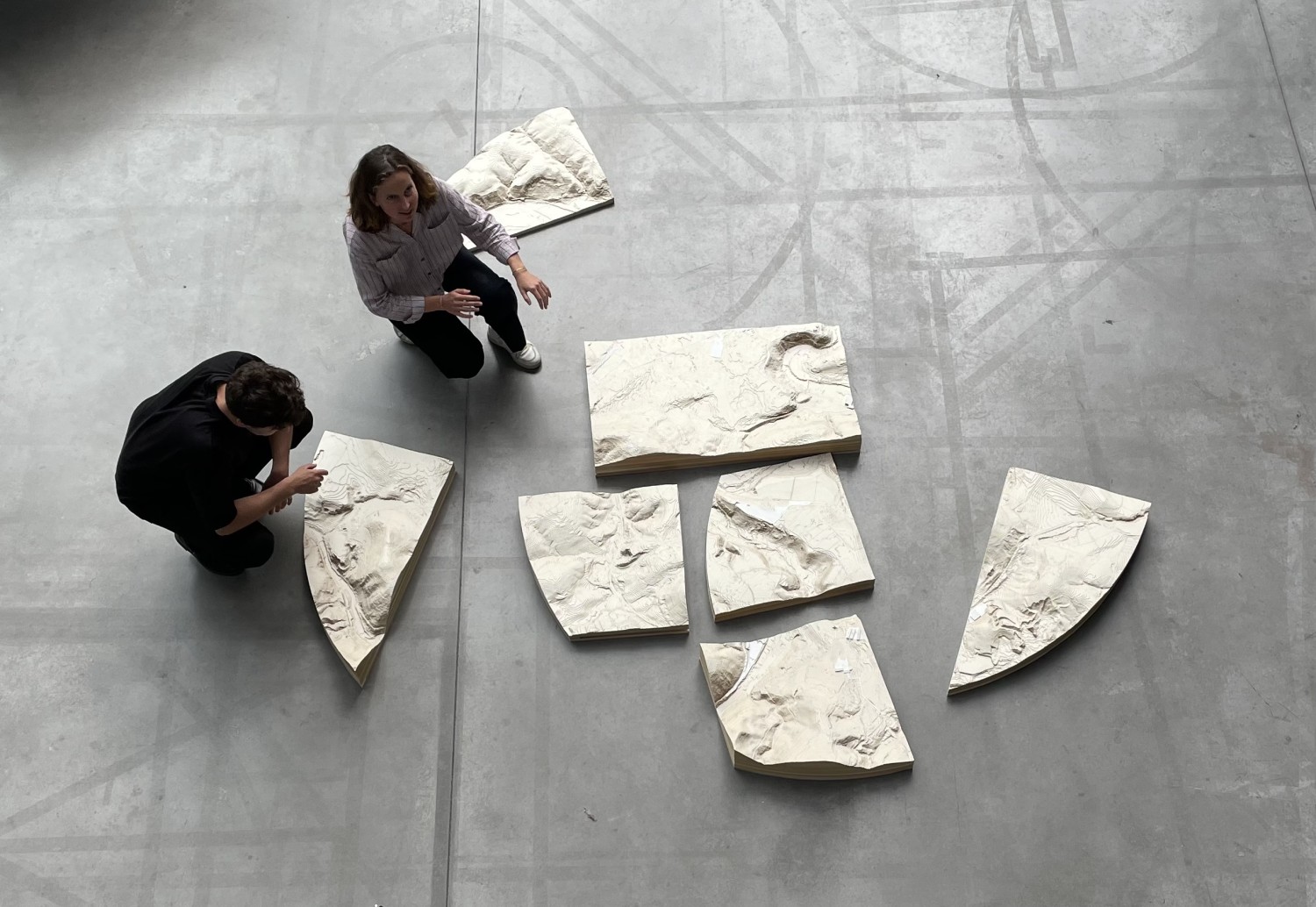
DSA Architect and Urban Planner
The DSA trains designers. It is aimed at qualified architects and landscape architects who are interested in the built environment and who are exploring how to build in the present day.
The term ‘urban planning’ commonly refers to a set of practices that lead to the development of cities and the built environment. Among these practices, the DSA focuses on formal design (urban design, landscape architecture). The diverse scientific and disciplinary contributions, together with training in the use of different scales, are harnessed to support an ecological approach that might be termed ‘territorial architecture’, or even ‘architecture of the Earth’ (terrestrial architecture). Just as one designs a building, one designs a riverbank, an embankment, a square or a platform, or a system of parks. The DSA programme trains students to work towards understanding and transforming all these elements and their underlying context, with the same attention to detail and the same sense of purpose.
Overview and key features
The DSA in Architecture and Urban Planning is a postgraduate programme leading to a national higher education qualification: the Diploma of Specialisation and Advanced Studies in Architecture, with a specialisation in ‘urban design’. It enables students to deepen their design skills in the fields of architecture, urban form, public space and landscape, whilst also acquiring new knowledge to understand decision-making processes, the interplay between stakeholders and the regulatory and economic frameworks, as well as technical and environmental challenges.
Led by Éric Alonzo, Professor (First Prize in the 2017 Manuel de Solà-Morales European Prize) and Pierre Alain Trévelo (TVK)
alongside: Gwenaëlle d’Aboville (Ville Ouverte), Thibault Barbier (Atelier Georges) and Julien Romane (Les Marneurs)
And also: Thaïs de Roquemaurel, David Énon, Sébastien Marot and Stéphane Füzesséry
The DSA brings together and deepens knowledge and practice in architecture, landscape architecture and urban planning in the service of territorial projects. For the realisation of architecture cannot be separated from the shaping of the world.
Contextual manifestos
The first two semesters of the programme are devoted to projects developed under the conditions of real commissions from public institutions or private organisations. This approach enables students to engage with the concerns and requirements of clients whilst maintaining a theoretical framework. The academic freedom offered by the DSA enables students to assert their own point of view and make their own choices. The work produced takes the form of a situated manifesto. The wide variety of situations addressed through these commissions enables students to draw lessons of a more general nature and to develop models intended for sharing within the academic and professional worlds.
Between the academic and professional worlds
The programme offers a dual focus on research and practical application. Issues explored by other disciplines and sciences inform students’ thinking through thematic seminars as well as through contributions from experts. Drawing on this solid foundation, the programme takes an exploratory and forward-looking approach. It enables students to articulate well-reasoned positions. Links with the school’s research activities are emphasised, particularly with regard to the work of the OCS (Observatory of Suburban Life) laboratory and the Coastal Studies Chair. Some DSA modules contribute directly to this research.
Field Trips
Field trips, in their many forms, form an integral part of the teaching programme. These trips are not mere visits. Surveying and slow walks help to shape a perspective and develop a formal representation of the territory, which constitutes the first stage of its transformation. Surveying work—systematic yet varied—enables students to grasp widths, lengths, depths and heights… all the dimensions that define an object and its place within the territory. Through this precise measurement work, students come to understand how an object functions within a territory. Trips, whether short or long, in France or abroad, to project sites or places of inspiration, form part of the learning process for a fundamental skill in territorial architecture: fieldwork.
The DSA teaching team believes that the territory is shaped, and that mastering this shaping requires designers to continue building habitable worlds.
With a view to training these designers, the programme is dedicated to teaching a range of practices:
- Mobilising knowledge
- Building
- Representing
- Reading
- Writing
- Arguing
Organisation
- 3 semesters (18 months);
- 90 ECTS;
- 1,800 hours, including 900 supervised hours and 500 to 600 hours of work-based learning;
Semesters 1 and 2
The first two semesters of the programme are organised primarily around the project workshop, supervised by Éric Alonzo and Pierre Alain Trévelo, co-directors of the programme, alongside landscape architect Thibault Barbier (ateliergeorges), urban planner Gwenaëlle d’Aboville (Ville ouverte) and architect and urban planner Julien Romane (Les Marneurs). This is complemented by teaching on argumentation, writing and visual communication. This workshop is periodically interrupted to make way for an intensive introductory seminar, themed weeks, optional modules and a study trip abroad.
Semester 3
Once this first year has been successfully completed, the DSA in Architecture and Urban Planning concludes with a professional placement lasting a minimum of five months. Students may combine their professional placement for the DSA in Architecture and Urban Planning with that of the HMONP. This professional experience is assessed through a thematic and problem-based dissertation, defended before a panel.
Thematic weeks
- Learning from built environments 1: intensive introductory workshop
- Représentation du projet territorial
co-ordinated by: Thaïs de Rauquemaurel, architect
in October - Infrastructure
co-ordinated by: David Enon, architect and urban planner (TVK)
in November - Paysage et environnement : un état des lieux théoriques
co-ordinated by: Sébastien Marot, philosopher, permanent researcher at the Observatoire de la condition suburbaine (OCS)
in December - Histoire et devenir des territoires habités
co-ordinated by: Stéphane Füzéssery, senior lecturer in history, permanent researcher at the OCS and architect (ABC Architectes Building for Capacity)
in January - Acteurs de l'aménagement et économie urbaine
co-ordinated by: Gwenaëlle d’Aboville, urban planner (Ville ouverte)
in February - Ecologie du territoire
co-ordinated by: Thibault Barbier, landscape architect and urban planner, co-founder of georges
in March
Admission
The DSA in Architecture and Urban Planning is aimed at qualified architects and landscape architects, whether French or from abroad. The selection process, which takes place from May to July, is based on a portfolio of work and, where applicable, an oral interview. The programme is available as an initial qualification and as continuing professional development.
How to apply as an external candidate?
Via the admissions portal Taïga select ‘Ensa Paris-Est’ from the drop-down menu.
Contents of the application pack
• a personal statement explaining the candidate’s areas of interest, motivations and intentions regarding the Post-Carbon Architecture programme,
• a curriculum vitae,
• a portfolio (maximum 25 pages) comprising any documents demonstrating experience and an interest in the programme’s themes (projects, coursework, dissertations, articles, etc.), supplemented by appendices if necessary,
• a copy of your degree certificate or proof of qualification.
For international students, the required level of French is the TCF: advanced level C1 (500 to 599 points) and a minimum mark of 14/20 in the written and oral tests, or DALF C1. All documents submitted in a foreign language must be translated into French.
Tuition fees
1,557 euros in the first year, then 520.50 euros in the second year. The course is eligible for a means-tested grant (applications to be made to the Crous in Créteil). For employees, this course is recognised by funding bodies such as Pôle Emploi or OPCOs.
Funding
All higher education institutions assessed by HCERES are deemed to have met the quality requirements for their entire range of courses. As such, they are exempt from the Qualiopi accreditation process for all the qualifications they award. Institutions exempt from this procedure are listed by the General Delegation for Employment and Vocational Training (DGEFP).
What next?
The DSA in Architecture and Urban Planning offers a range of career opportunities:
• urban planning roles involved in project development and project management: private or public agencies and consultancy firms, local authorities, and semi-public companies (SEMs).
• Preparation for the State architect-urban planner competitive examination, specialising in urban planning and development.
• Opportunities to join the School of Architecture’s research team: the Observatory of Suburban Conditions (OCS) and the doctoral programme.
Programme Directors
Éric Alonzo
Pierre Alain Trévelo
Coming soon
les cahiers du DSA
At a glance
ECTS credits: 90
Duration: 18 months
Level of study: 6.5 years of higher education
Contact:
Initial training
Stacy Saillard
Tel. +33 (0)1 60 95 84 68
Presentation of the DSA on Youtube
Enrolment
Enrolment for the 2026–2027 academic year is now open
Taïga portal guide
portail de préinscription
Documents to download
flyer